The CCiiff Film Festival ended last night when the final film, Empire of Silver (Bai Yin Di Guo), VO Chinese with English subtitles, screened in Revel. The festival was truly a bringing together of many cultures, with films coming from China, Africa, Europe, South America, USA, ..., with many points of view and in many languages, subtitled in French or English.
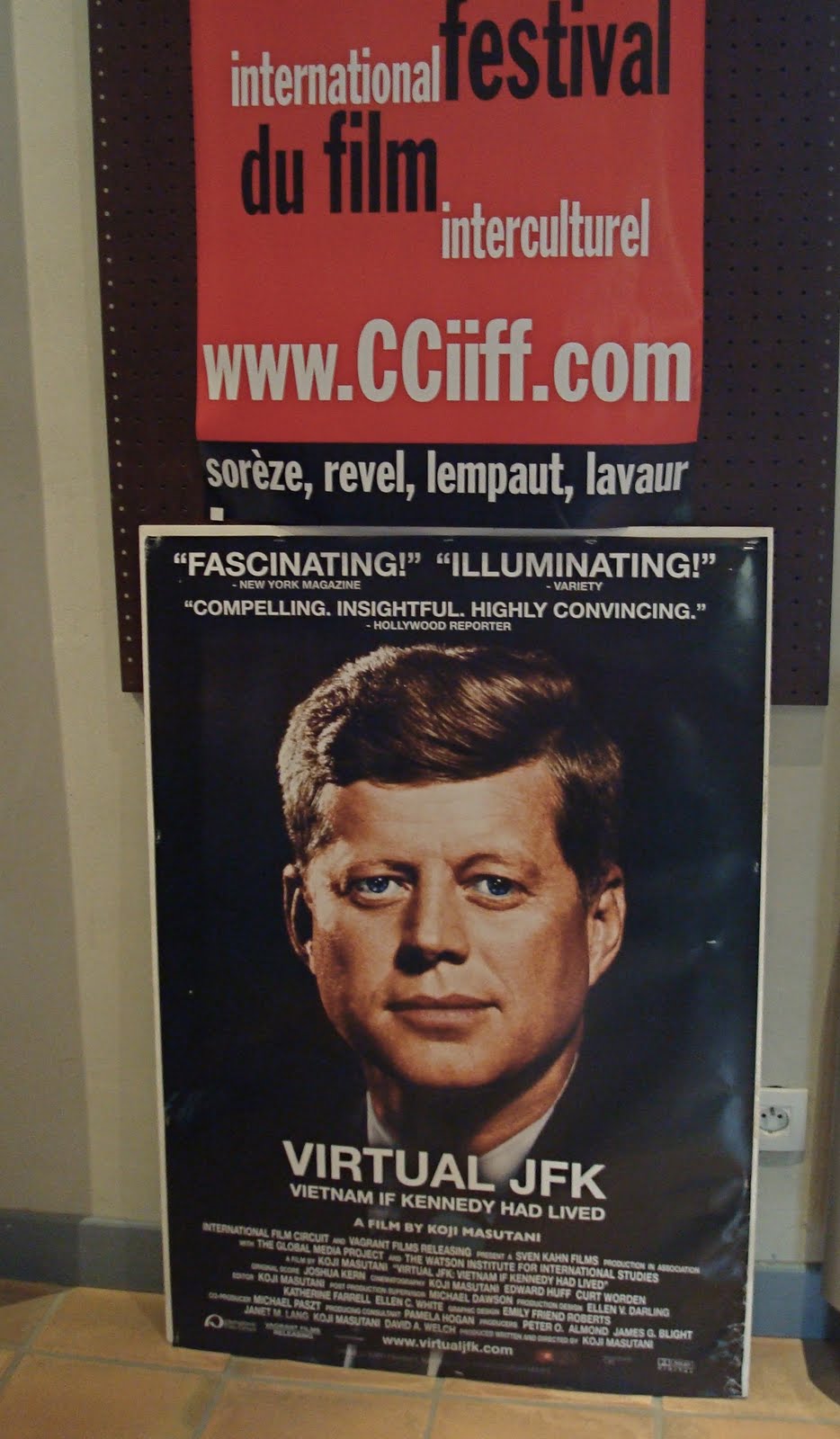
Of the 13 films which I saw in the ten days of the festival, there was one which gave me some new perspective on my own country and where we are today: Virtual JFK: Vietnam if Kennedy Had Lived, which screened last week in Soreze at the Abbaye auditorium.
Virtual JFK focuses on "the way President Kennedy dealt with six important foreign policy crises (Cuba to Vietnam) without going to war. The film puts forth the argument that "critical decisions about the use of restraint and coercive diplomacy often require greater acts of courage than the use of force and that character matters greatly in Presidential leadership." Koji Masutani, Director of Virtual JFK
Virtual JFK focuses on "the way President Kennedy dealt with six important foreign policy crises (Cuba to Vietnam) without going to war. The film puts forth the argument that "critical decisions about the use of restraint and coercive diplomacy often require greater acts of courage than the use of force and that character matters greatly in Presidential leadership." Koji Masutani, Director of Virtual JFK
Masutani was born in Tokyo, Japan, in 1981. He spent most of his childhood in Hong Kong before attending a private boarding school in Massachusetts. He received a Bachelor of Arts in International Relations from Brown University in 2005.
 The movie uses archival footage to review the ups and downs of Kennedy's presidency and the public and staff/advisor pressures that were put on him at and after each of the crisis decision points.

The six crises with which Kennedy dealt during his presidency that are the focus of this film are: Bay of Pigs (April 1961), Laos Crisis (1961), Berlin Wall Crisis (August-November 1961), Showdown over Vietnam (November 1961), Cuban Missile Crisis (October 1962) and, finally, the Vietnam Withdrawal (October 1963).
 The movie uses archival footage to review the ups and downs of Kennedy's presidency and the public and staff/advisor pressures that were put on him at and after each of the crisis decision points.
 In dealing with Vietnam shortly before he died, JFK agreed to a plan devised by Defense Secretary Robert McNamara to withdraw most Americans in South Vietnam by late 1965, with the first 1,000 to be withdrawn within three months.

JFK’s plans were reversed by his successor, Lyndon Johnson, who decided to increase the American presence in Vietnam to 500,000 troops. The war stretched across several generations and killed more than three million Vietnamese and 58,000 Americans.
You can read a more thorough synopsis of the film on this Virtual JFK site page under Press Material.
One of the things I liked about this film was that I did not find it polemical, but rather felt that it invited viewers to draw their own conclusions.
When Kennedy was elected in the Fall of 1959, I had just turned 11 years-old and was living with my family in a house out in the countryside in Hertfordshire, England. My father was a Lt Colonel in the US Air Force and was on assignment there. We did not have a television at home for our entire stay in England. Our main source of news and entertainment in the evening was the BBC on the big old radio in the living room. We did not return to the US until the summer of 1962, when we moved to our next posting at Langley AFB in Virginia.
As I remember it, my father felt connected to Kennedy and proud of his election to the presidency. They were both of Boston Irish Catholic stock, my father from Quincy, on south Boston Bay, and Kennedy originally from Brookline, some eight miles inland from Quincy; both had red hair and three brothers; both went to Catholic school and fought in WWII in the Pacific theater.
But after watching this movie, I suspect my father must have felt conflicted as the Kennedy presidency progressed, for Lt Col Wm J Norton, my father, was a committed, career Air Force man who, I discovered through recent research, was part of the support team (a weather group commander) for spy missions over central Europe and Russia. As Virtual JFK documents, Kennedy decided time and again, against the advice of his military advisers and to much scorn from hawkish Republicans, not to use military force.
A lot of the old film footage from the Kennedy years showed him fielding questions from an auditorium filled with reporters. He gave smart, powerful, informed answers often balanced with humor. In comparison, the presidential press conferences I have seen through much of my adulthood seem overly managed, the president often ill-informed or less than candid. Admittedly, I generally avoid broadcast television and have done for much of the past thirty years. But you cannot avoid seeing clips and I have watched my fair share.
I was a sheltered and naive 14 year-old and just starting the ninth grade when Kennedy was murdered. I remember being stunned and knowing in my gut that this was a very bad thing for the US. I had similar feelings, astonishment and dismay, after watching Virtual JFK.
That is what a strong, intelligent president who is willing to stand up for peace looks like, I thought. I wasn't old enough to realize that at fourteen.
What a loss.
"The United States, as the world knows, will never start a war. We do not want a war. We do not now expect a war...We shall be prepared if others wish it. We shall be alert to try to stop it. But we shall also do our part to build a world of peace where the weak are safe and the strong are just."
Excerpt from John F Kennedy
Hugs from Afar,
N2