Showing posts with label south of france. Show all posts

Tuesday, October 23, 2012

Le Marché du Samedi (The Saturday Market)


La Bastide* de Revel

In every season, one of my favorite things about being in this part of southwest France is the Saturday market in the center of Revel.  When I first stayed in Soreze for three days some ten years ago, I was introduced to this market. There I bought supplies to make a meal for the friends I was staying with and fell in love with the ambience of the Revel market.  Whenever I am in Soreze, I look forward to doing the bulk of my grocery shopping at the market each Saturday morning.

*Bastides -"new towns" of the Middle Ages (thirteenth and fourteenth century), located in the southwest of France characterized by a very specific architecture : a central square surrounded by arcades where the streets converge.  www.tourisme-revel.com


I try to make most of my purchase sous la halle (under the market hall, built in 1342) as that is where the local producers and farmers sell their goods. There are a growing number of "Bio" (pronounced bee-oh) farmers who sell here, and bakers, cheese, confiture, wine and sausage makers  who use organically grown flours, milk, fruit, and pork in what they make.


The vendor above on the left, who grows and bakes with organic grain, is one of my first stops for a small apple, pear or fig tart. I've settled on the vendor, above right, that bakes with levain nature for my whole wheat walnut or sesame bread.  You can buy a whole or half loaf, which I find a common sense option for people who are living tout seul (alone), so they can have their fresh bread, too.

 
There are several good, local chèvre producers that I cycle through, depending on the length of the line, and several hen wives (as Ms Moon might say) who specialize in farm fresh brown eggs for ~2€ ($2.60) a dozen.  The eggs might all look pretty much the same, but I must say I was thrown off balance when my favorite hen wife quit coming to market this year and I had to decide on another one.


In the outer ring, sous les parasols (under the umbrellas), there are many more vendors with big rounds of cheese, barrels of olives and a large selection of fruits and vegetables, some also from this region and some from Spain, Morrocco or even the USA.


There are always seasonal specialties.  This week it was cepes mushrooms from the forests of the Montagne Noir (Black Mountains), the range of wild and unspoiled countryside dotted with lakes and small medieval villages, which lies just above the Lauragais in which we live.

I purchased one of the smaller cepes, though as you can see from its comparison here to the chunk of pumpkin that I bought, this one mushroom was enough to make a bit of sauce (slice mushroom, sauté in butter, add a bit of crème fraîche and white pepper to taste) to go with the rôti de porc that I roasted for Sunday dinner.


Not sure if one enterprising farmer was anticipating a Thanksgiving dinner for local expats, but I sighted a pair of Dindon Royal (Royal Turkey), 40€ (~$50) for "the couple", no doubt a more gamey, less pumped up choice than a Butterball.


When I am through shopping, I ritually join the locals in parking my panier (indispensible rolling shopping bag), having a cup of coffee and eating my little tart at one of the cafes under the gallery that surrounds the market square.


Another satisfying haul from the Saturday market to be enjoyed all week and beyond.


Baisers de l'angle sud-ouest de la France!
N2

Wednesday, April 18, 2012

Ein Deutscher Wochenende (A German Weekend)

On the way over to France I stopped off to see some friends in Germany. The town of Hildesheim where they live is near Hannover, i.e. in the northern part of central Germany. It's only a 2 1/2 hour drive to Berlin from there, I was surprised to find, or only 2 hours on the train. This is Europe, so that is a dependable two hours on a train that picks you up and drops you off on time. (I once went on a work trip in CA on Amtrak and the train was four hours late. I think there'd been a cow on the tracks... or something...)


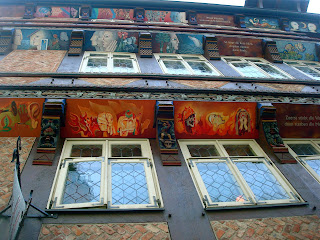
A remarkable fact about Hildesheim is that the historic market square, pictured above and below, was completely leveled when the Allied air force ran the eighth and largest bombing mission on Hildesheim, a city of little military significance, on March 22, 1945, a little over six weeks before the Germans surrendered unconditionally to the Allies in Berlin.

According to Wikipedia, during the bombing "250 bombers dropped a total of 438.8 tons of high explosive and 624 tons of incendiary bombs. Almost 74% of the buildings in Hildesheim were destroyed or damaged during the attack, including nearly the entire historical city centre. About 1,500 civilians were killed in the attacks in March, of which about 500 could not be identified." It was a firestorm, is what my German friends have been told. (They didn't grow up in this area and were born after the war.) Like Dresden, only lesser known.


Between 1984-1990 the historic center was reconstructed using the old methods of construction as much as possible. I thought it was interesting that there are modern art and anti-war scenes cached on the undersides of the facade. (See picture above right).


A couple of small sections of the old town still exist and they give you a feel for what was lost. Hildesheim is one of the oldest cities in this part of Germany. It became the seat of the bishopric in 819 and was an important market town on the Hellweg, an ancient east-west trade route between the Rhine river and the mountains.


It's definitely Spring time in Germany. The Spargel, white asparagus, the German's aren't really interested in any other kind, is in the market, along with new potatoes and the first local strawberries. You know we had to try some of each, especially Spargel -- my friends have schooled me in the niceties of those fat white spears.


Spent some time at the Hannover Porsche dealership while K got the winter tires on his work car, a Cayenne (Porsche's version of the SUV), changed for the summer ones. It's a classy place with the expresso bar open and free for customers while they wait. I was liking the lines of the new Panamera Gran Turismo, which comes in high performance diesel, hybrid and regular gas models. But at twice the price of the Cayenne and a longer footprint, even K, a very Germanic flashy car type of guy, thought that would be a bit of a pig to drive. Even if I'd won the lottery for instance and had that kind of money that I would be willing to put on the street in the shape of a car. But a gal can fantasize, non?

Settling down into some concentrated writing time now that I'm in my little French village.
More soon, Küsschen for now.
N2

Wednesday, March 9, 2011

Citrons Atomique


I have a Meyer lemon tree at the back of my yard in California. It was a birthday gift over twelve years ago from my friend G, who knew how much I loved Meyer lemons.

I got my first taste of this extra-ordinary lemon when I moved into my California bungalow, 25! years ago it was now. (Long before the CA foodies jumped on the bandwagon.) My neighbor Gladys, who lived alone in her house after her husband died until she was 95, but has sadly passed on, had a Meyer lemon tree growing on the side of her house. My son would mow her lawn in trade for our use of her lawnmower to mow our own lawn. She always felt she needed to even out the trade by giving me some lemons from her tree.

I've had a long term fondness for lemons anyway. I think it started when I was 10. I read about Amy March in "Little Women" getting in trouble for sneaking bites of "lemon pickle" during class. My mouth started to water and I'd never even seen a pickled lemon. I tried to recreate what I though the taste would be by eating a slice of lemon with salt on it. I know your face might be crumpled up in a sour sort of way right now, but I Loved It!

Those lemons from Gladys were just the beginning of a deeper lemon addiction. The really good Meyer lemons (for me, that means the old, not "improved", variety), have a thin, glossy skin and the fruit has an orange tinge. Thought to be a cross between a lemon and a mandarin orange, they remind me of a kumquat in that the skin is almost sweeter than the fruit, though they are certainly not as sour inside kumquats. I like to eat them chopped into salad, peel and all. Hell, I like to eat them sliced and dipped in a little French sea salt. **My mouth is watering here. I kid you not. I have to go to the kitchen and dip a slice of lemon.**


I got my own Meyer lemon tree those twelve years ago and it lived awhile in a large pot while I tried it out in different locations to find where it would be happiest in the yard. When I finally put it in the ground there in the back corner, it took awhile to really start producing. My brother stayed with me a couple of years ago and clued me in to giving it special citrus fertilizer. This year I had about 100 lemons on my own tree. Finally a decent crop! In the intervening years I have had to beg, borrow and stea..., well, indulge in a little midnight harvesting to find sufficient Meyer lemons to quench my thirst.

When I was working and living in Madrid for a year, a CA friend shipped me a dozen Meyer lemons, put in an egg carton and then double bubble-wrapped. A work pal who was sharing my apartment over a few months dubbed them "atomic lemons" because they never went bad. He didn't realize that they had been airmailed fresh off the tree or that I was nurturing them along, washing and airing them out from time to time in order to make them last until my next trip back to CA.

When I came to France in February, I brought twelve of my own Meyer lemons with me. Last week I made a batch of lemon bars in a round pan and served it sliced as a tart au citron when I had a few people over for dinner. I also gave slices to my favorite neighbors here on Rue Ferlus. This evening, Elodie from next door stopped me and told me "La tarte au citron - un petit morceau avec une tasse de café? Impeccable! (Pronounced IM-peck-ahb-leh and said with a gourmet's twinkle in the eye and a little kiss to the fingers.) So the Meyer lemons are a hit here, too, at least when they are tarted up.


The lemon bar recipe I used was one I found on the smittenkitchen blog. It seems very reliable from my two attempts at making it and gives you the option of a thick gooey topping or a thinner one. I made it in CA in a gas oven and here in an electric, both times with stellar, if a bit different, results. I used superfine sugar and that made for a thin, meringue-type of top to the bars which meant they didn't need any powdered sugar sprinkled over them. It's a recipe that is on the tangy side. Right up my lemon lovin' alley.

Lemon puckered kisses,
N2

Friday, September 17, 2010

'Mater Matters

It took until the end of August and into September for the tomatoes to really start to ripen well this year. But ripen they finally did, I am here to report.


'maters and the purple beans. Grew these beans from seed my neighbor Ren saved. She didn't get many purple beans, but got the purple speckled "neighbor beans" from seed I saved. So we both had neighbor beans.


I was picking a basket this size about every four days for the three weeks before I left CA.


Real slicin' 'maters - big red "Mortgage Lifters", yellow "Purple Smudge" and little but tasty "Black Brandywine". The salsa was great for breakfast with local eggs, avocado and corn tortillas.

Fabulous just to look at in the afternoon kitchen light.


I ate as many as I could, gave some away (that double-sized "Big Yellow Oxheart" in the top picture went to my son and daughter in law in San Francisco, where the garden tomatoes didn't quite make it this year), and made several batches of baked tomato sauce. Couldn't be easier: olive oil the 9/12 glass dish, cut tomatoes in quarters, put in dish with several un-peeled cloves of garlic, bake at 350 for 1/2 hour and then leave in the warm oven overnight. Presto: tomato sauce to freeze. (I squeeze the garlic cloves out of their skins into the sauce after it is done and take out some of the tomato skins.)


They were still comin on pretty strong, so I had to pack these up in a big plastic container and bring them with me in my carry on when I flew over to France. I haven't found this variety of heirloom tomatoes in our fabulous Saturday market in Revel, at least thus far. Can't wait to buy eggs from the sweet farm wives, olives out of a big half barrel, walnut bread with levain nature and local goat cheese and yogurt au marché le matin.

More soon from Soreze.
Bises,
N2

Monday, January 11, 2010

Day 5 of the Picture Dialogues

Breakfast by the fire this morning, reading Netherland by Joseph O'Neill (see sidebar) before starting work in the study.

Saturday, January 9, 2010

Day 3 of the Picture Dialogues


Left was yesterday morning and right is today. And the snow is still sifting down.

Sunday, October 11, 2009

Troubadors, le Sidobre and the River of Rocks


Last Wednesday, M, D and I drove up to le Sidobre, an area east of Castres (22 miles/ 35 km from Soreze). On the way up, we stopped off in Burlats, the site of the court of the fair Adelaide of Béziers from ~1170-1199, a significant center for trobadors (troubadors) -- composers and performers of Occitan lyric poetry during the High Middle Ages (1100–1350).

Burlats
In the area of le Sidobre 300 million years ago, molten magma was trapped several kilometers under the Hercynian Range of mountains. According to Encyclopedia Britannica, this range once "extended through western Europe for more than 1,860 miles (3,000 km), from Portugal, Ireland, and England in the west through Spain, France (Brittany, Massif Central, Vosges, and Corsica), and Germany (Black Forest, Harz) to the Czech Republic in the Bohemian Massif."

Over the intervening millennia, the mountains eroded to the point that, today, in this area of France, only the Massif Central, the Montagne Noire, and the Sidobre remain. During the period of the erosion, the magma was brought to the surface and cooled to form crystalline rock composed of mica, quartz, and feldspar -- granite.


Simply put, you could say that le Sidobre is a block of granite measuring 6.2 miles (10 km) in length, width and depth. The visible surface was cracked, while below the rock remains a solid mass. Runoff from rainfall, drainage and infiltration created a constant flow of water through the surface cracks and carved the boulders into remarkable shapes.

We walked up to Saut de la Truit (Trout's Leap), had lunch at Lac de Merle (Blackbird's Lake),

Lac de Merle


were dwarfed by the Peyro Clabado (Nailed Rock) and le Roc de l'Oi (Goose Rock)


and, my particular favorite, walked through le Chaos de la Roquette(the River of Rocks).

What a way to put things in perspective!

Thanks to Derek for sharing his camera when my battery died and for the use of some of his pictures in this post.

Bisous,
N2

Wednesday, September 30, 2009

Le coeur vivant de la Cité


On my past visits to this corner of France, I have never spent much time in the center of Toulouse, the fourth largest city in France, after Paris, Marseille and Lyon, so yesterday my Soreze friend M showed me some of her favorite sights in the "living heart of the city".

Though construction on the original building to house the regional government in the center of Toulouse was started in 1190, the
current façade of Le Capitole (the Town Hall, above), built of the distinctive pink Toulousian brick, dates from 1750. Inside we visited les salles Gervais, des Illustres et Henri-Martin to view the walls and ceilings painted by Paul Gervais, Benjamin Constant and others, and Henri Martin (impressionist stylist) respectively.
Then we walked a few blocks over to Les Jacobins, church and cloister. The church is an amazing space with 92-foot-high ribbed vaults supported by “palmiers”, single columns whose ribs fan out resembling a palm-tree. The church was part of the former monastery of the Dominicans, an order founded in 1235 to fight the Cathar religion. It is the site of the final resting place of the remains of St Thomas Aquinas, the Dominican priest, theologian and influential philosopher of the 13th century.


As we walked back through the city to the metro station, the students from the University of Toulouse, first established in 1229 and the second largest in France after Paris, were out enjoying the sun.

I felt like I'd just started to get to know la Cité. I'll have to find the time to make the short drive from Soreze again soon.

Bisous,
N2
Related Posts Plugin for WordPress, Blogger...